
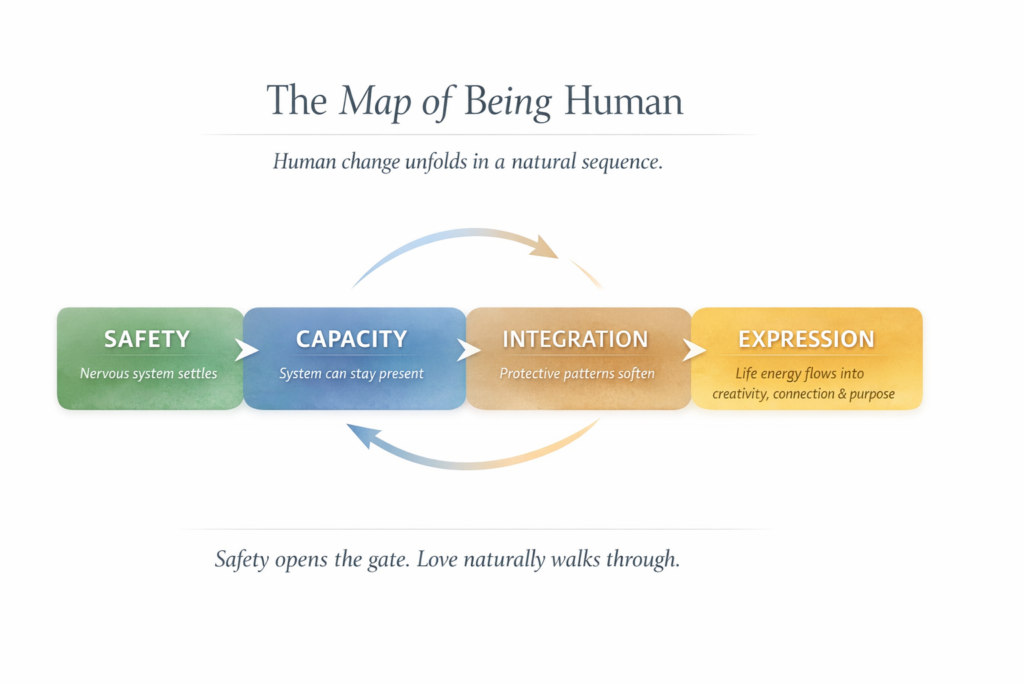
After more than forty years of personal and professional exploration, I’ve created something simple that helps make sense of why change can sometimes feel so difficult.
The Map of Being Human offers a compassionate framework for understanding how the nervous system organizes around safety and how growth naturally unfolds when the conditions are right.
There is something I’ve been quietly working on for many years now. Okay, maybe not so quietly…
Not as a project, but more like something that has slowly been taking shape over forty years of my own personal growth, my professional work training and mentoring therapists, coaches, and wellness practitioners, and endless courses of continuing education.
Piece by piece, insight by insight, something has been evolving.
Recently it reached the point where it felt ready to be shared. Kind of like the map itself is saying, “Okay Nancy… we’re ready. It’s time.”
So today I’m introducing you to The Map of Being Human.
Before I tell you about the guide itself, I’d like to share a moment that has stayed with me for decades – something that I recognize as the seed of how I see this work of serving both myself as a human being and the people I work with.
Back around 1990 I was teaching business at a post-secondary institution here in Ontario. I was also chair of our professional development committee, and one year we invited a professor of education to come and lead a development day for our faculty.
I remember picking him up at the airport, and as we drove back toward campus he asked me a simple question.
“What do you teach?”
I replied, “I teach business.”
He paused for a moment and then said something that has stayed with me ever since.
“No, you don’t. You teach students. Business is just the vehicle you use to do that.”
At the time it seemed like a small comment, but clearly it landed somewhere deep in me, because over the years it has resurfaced again and again as my work evolved.
Years later, as my work moved into therapy, coaching, and mentoring practitioners, I began noticing something similar happening in our healing fields.
We have become increasingly focused on techniques.
Techniques for calming stress.
Techniques for changing thoughts.
Techniques for shifting emotions.
Of course many of these techniques can be helpful. I use them myself. I’ve spent decades studying traditional therapeutic approaches, energy psychology, EFT, somatic work, emotional processing, trauma-informed practices, and many other ways of supporting people. Each of these has offered valuable tools, and I remain deeply grateful for what they have contributed to my understanding.
And right from the beginning, something about the emphasis on technique felt incomplete to me, and it has worried me.
It brought me back to that conversation years earlier in the car. Because just as I wasn’t really teaching business, I’m not really working with techniques.
I’m working with human beings.
And human beings are living systems.
Living systems are complex and they organize themselves in certain ways, especially around safety. Once you begin to understand that, many things that once felt confusing suddenly start to make sense.
People are not broken.
Their nervous systems are simply doing what they were designed to do.
Over the years I began to see something else as well.
Techniques used without an understanding of the larger framework of being human can feel a little like walking onto a construction site with a toolbox but no blueprint.
You may have excellent tools, and you may even know how to use them well. But without a clear sense of the structure you’re building, it becomes difficult to know which tool is needed in a particular moment or what the next step should be.
And the quality of the tools isn’t enough for safety on the job site.
This is something I see often when current and aspiring practitioners come to train with me. Many of them arrive having already learned a number of techniques from different approaches. What they are really longing for is a way to understand the bigger picture. They want to know where a client might be in their process and how to support them in a way that allows the nervous system to move safely and naturally toward growth.
At the same time, the individuals who come to see those practitioners are often carrying a very different question. They are quietly wondering why change sometimes feels so difficult, even when they genuinely want it.
Slowly, through years of working with both groups, something began to take shape.
A framework. A paradigm shift. A way of understanding the journey of being human and the natural phases through which our nervous systems move as we grow and change.
That framework is what has become The Map of Being Human.
The Map helps us understand why the nervous system prioritizes safety before growth, how our capacity to experience life gradually expands, and why change tends to unfold in stages rather than all at once.
For many people, simply understanding this brings a tremendous sense of relief. Experiences that once felt like personal failure start to look very different when we see them as natural protective responses inside a biology that has been trying to keep us safe.
And for practitioners, the Map offers something equally helpful. It gives us a way to orient ourselves in the process so that the tools we use are applied at the right time and in the right way.
In other words, the techniques finally have a context.
And when the context is clear, the whole process becomes much kinder and much more effective.
If what I’m sharing resonates, I’d love to share it with you.
You can download The Map of Being Human: A Gentle Introduction to Conscious EFT and the Human Pathways of Safety and Transformation here.
It’s a short guide, about twenty pages, but it offers a way of understanding something many people have quietly struggled with for years.
Why change sometimes feels difficult, even when we truly want it.
And perhaps even more importantly, it offers a kinder way of understanding ourselves.
The intelligence for healing and growth already lives within you.
Sometimes all we need is a map that helps us understand the journey.
Warmly,
Nancy