

A small pattern in my right knee turned out to be a quiet lesson in how intelligently living systems adapt. This simple story illustrates a central principle of The Map of Being Human: when safety increases, the body – and the nervous system – can reorganize in surprisingly elegant ways.
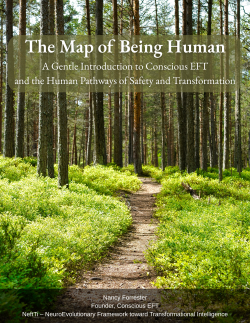
In my last blog, where I introduced the new guide to Conscious EFT called The Map of Being Human, I wrote that human beings are living systems, and living systems organize around safety.
(If you haven’t seen it yet, you can download it here before reading further.)
Today I want to offer you an example of what that natural prioritization of safety has looked like in my own body.
For about thirty years I’ve been aware of a pattern in the back of my right knee. It wasn’t pain exactly, and it certainly wasn’t dysfunction. I could walk, move, exercise, and live my life quite normally. It was simply a tight, blocked sensation.
I could live with it, and mostly I did.
The only time I would really notice it was when I would do a yoga pose like child’s pose. My right knee simply wouldn’t bend as much as my left. Again, no pain, but the difference was very clear. The left side folded easily. The right side quietly said, “That’s far enough.”
So I lived with it.
But I was aware that it was there.
What eventually became important was not where this pattern may or may not have started. What mattered was how it was showing up in current life. That became the place to put the magnifying glass.
Not into the past.
Not into a long search for what might have happened when I was four years old.
Not into an urgent detective story asking When did this start?
Instead, into today.
What is this pattern today?
And what is it asking for today?
For many years I had made the obvious assumption. I assumed it was a knee issue. That’s where I felt the sensation, after all. And like most people, I heard the familiar conditioned thoughts that circulate in our culture.
Maybe it’s arthritis.
Maybe this is just what happens as you get older.
Maybe there isn’t much you can do about it.
But recently, after I wrote The Map of Being Human, I began looking at this pattern with a little more curiosity and a lot more compassion.
And something different started to emerge.
What I began to see was that my body had organized itself in a particular way over a very long time. The pattern involved far more than the knee itself. It had to do with how my hip, glute, hamstring, calf, and the small structures behind the knee had been working together – or compensating for one another – for years.
In other words, my body had adapted.
Adapted to something. Perhaps an old injury, perhaps a moment of strain, perhaps something emotional or energetic. I honestly don’t know.
And what if I don’t need to know?
What became much more interesting is the nature of the adaptation itself. What if the body is an integrated system that is always trying to help.
That tight sensation behind my knee was not evidence that something had gone wrong. It was evidence that my system had found a way to keep me functioning. It had organized itself around protection and stability in the best way it knew how.
For practitioners this is such an important thing to remember. And for everyday humans too.
What we often call a problem may in fact be an intelligent adaptation to a previous experience of insufficient safety. The system is doing its best to preserve function, reduce threat, and keep life moving.
Once I saw that, the quality of my questions began to change.
Instead of asking:
Why did this happen?
How did this happen?
When did this happen?
— all questions with a certain urgency behind them —
a different question began to emerge.
What does this pattern need today in order to feel safe enough to soften the protective pattern and strengthen the more coherent one?
Or even more simply:
What does safety for this pattern look like today?
That is a very different kind of question.
It doesn’t pull us backward into a search for certainty. It brings us into relationship with the living system that exists right now. It invites curiosity instead of diagnosis and creates space for something new to emerge.
And this is something I’ve noticed over and over again in my work:
More coherent questions often create more coherent answers.
If I’m honest, I still have no idea where this pattern began.
Maybe I fell off a swing when I was five years old. Maybe there was an emotional moment in my life where I felt unsupported. Maybe it came through the way my body physically organized itself over time. Maybe there are family patterns, energetic inheritance, or epigenetic threads involved.
I honestly don’t know.
And it doesn’t actually matter.
The action is today.
And today the action is about safety, not force.
So rather than trying to stretch or push my knee into submission, I began doing a few very gentle exercises that supported the system more globally. Tiny movements that invited the hip, the glutes, and the surrounding muscles to participate differently.
Nothing heroic.
Nothing forceful.
Just a few quiet signals to the system that perhaps it no longer needed to do things the old way.
What I’ve been noticing is not a dramatic miracle, but something quieter and, in many ways, much more interesting.
My hips feel more flexible.
My glutes feel like they’re waking up.
The bridges have become easier.
My whole lower half simply feels more fluid.
In the language of Conscious EFT, I might say that the system is moving toward greater coherence.
And that is exactly what I mean in The Map of Being Human when I say that living systems organize around safety.
Whether we are looking at muscles, movement patterns, emotions, or relationships, the principle is the same. The system adapts in order to protect. And when conditions of safety increase, it begins to reorganize toward greater ease, coherence, and flow.
Nothing in my knee needed to be fixed.
What was needed was understanding.
What was needed was a better question.
What was needed was support that allowed the system to feel safe enough to try a more coherent pattern.
For thirty years my body had been faithfully stabilizing a system the best way it knew how, simply doing its job.
And when I approached that pattern with curiosity rather than correction, the body began to reorganize itself – just as our nervous systems do when we feel supported rather than pushed.
That, to me, is the heart of the Map.
If you haven’t yet downloaded The Map of Being Human, you can do that here.
It offers a simple framework for understanding why our systems adapt the way they do and how change begins to unfold when safety comes first.
And I would love to hear what you discover as you explore it.
Fluidly yours,
Nancy